
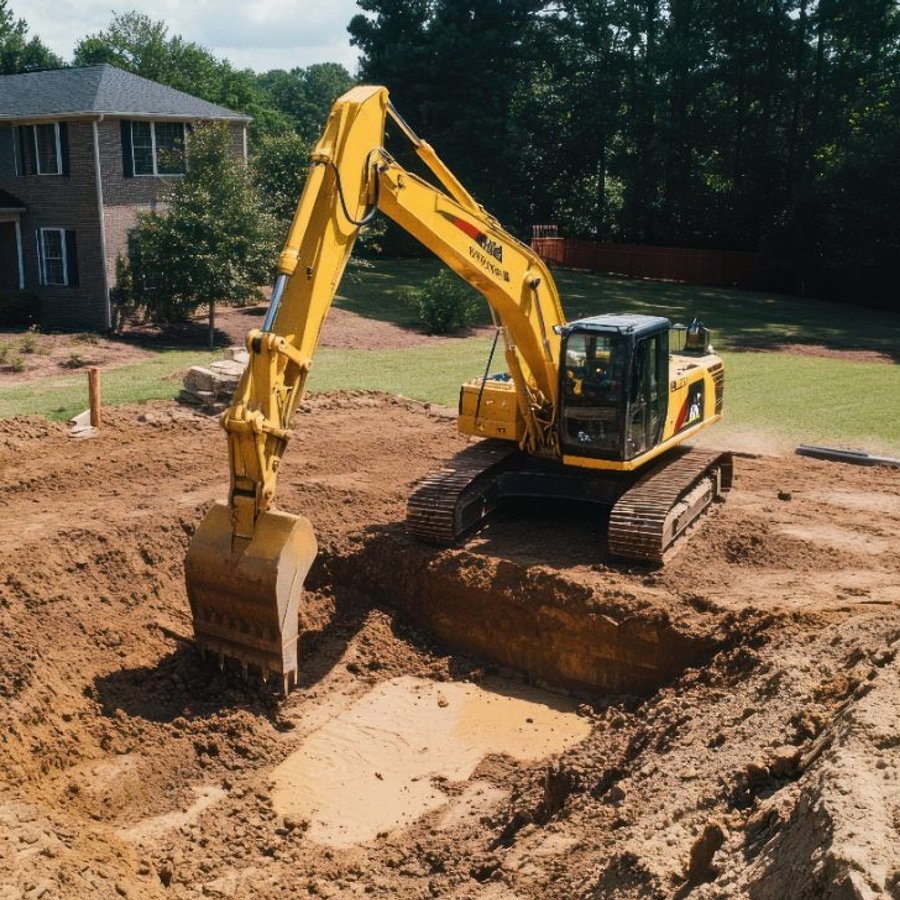
Excavation Services in Middlebury, VT
We head up to Middlebury regularly for site preparation, septic, and land-clearing work, from new home lots to established properties.
John Trombley Construction is a family-owned excavation contractor serving Middlebury and the surrounding area. Here's what we handle:
- Site preparation & grading
- Land clearing & tree removal
- Septic system install, repair & pumping
- Trenching & water lines
Every estimate is free, and emergency service is available when you need it. Reach out and we'll come take a look.
Get A Free EstimateExcavation and Site Work in Middlebury's Champlain Valley Ground
Middlebury sits in the Champlain Valley, and the ground here doesn't behave like the thin, rocky soil you find up in the hills. Down in the valley the soils run deeper, mostly clay loam and silt loam that hold together and hold water. That depth can be a real advantage for building, but it comes with a catch: these soils only drain moderately, and when they get saturated they stay wet. For anyone putting in a new home site, a driveway, or an addition around Middlebury, how you handle that water is usually the difference between a job that lasts and one that gives you trouble a few winters down the road.
John Trombley Construction is a family-owned excavation outfit based in Castleton, and we make the trip up to Middlebury regularly for site preparation, land clearing, and foundation digs. Our work covers the full range: excavation and site prep, land clearing and tree removal, septic installation and repair, septic tank pumping, trenching and water lines, demolition, and snow removal come winter. We give free estimates on all of it, and we keep emergency service available for the times when something can't wait. When we grade a lot in the valley, we're thinking about where the water goes first, because on moderately draining clay that's the question that decides everything else.
Vermont's building code sets a minimum foundation depth of five feet, sixty inches, and that number isn't arbitrary. Footings and buried utilities have to sit below the frost line, or the freeze-thaw cycle will lift and crack them, what folks call frost heave. On Middlebury's clay-heavy ground that rule matters even more, because saturated clay holds moisture right up against the foundation and can heave hard when it freezes. We dig to depth, we set footings on stable ground, and we build in the drainage that keeps water from pooling where it shouldn't.
Septic Systems on Valley Clay and High Water Table
Septic is where Middlebury's ground really shows its character. Every septic system in Vermont starts the same way, with a site and soil evaluation, the perc and soil test, done under the state's Wastewater System and Potable Water Supply Rules. That evaluation looks at the soil type, how high the seasonal groundwater sits, and how deep it is to bedrock. Those three things decide what kind of system your property can carry, and around Middlebury the answers tend to point in a particular direction.
The clay loam and silt loam common in the Champlain Valley drain only moderately, which means the ground can't move wastewater through as quickly as sandier soil would. On top of that, Middlebury has plenty of low ground, and near Otter Creek and the flats around it the water table can sit high. When you combine soil that drains slowly with groundwater that's close to the surface, a standard in-ground drain field often won't pass, because there isn't enough clean, unsaturated soil beneath it to treat the effluent properly.
In cases like that, the state rules typically call for a mound system. Instead of putting the drain field down in the wet native soil, we build it up above grade with imported sand and gravel, creating the separation the treatment needs. Middlebury's clay-and-high-water-table combination is exactly the kind of site that lands on a mound or a larger engineered system, and these soils also tend to need a bigger septic footprint than you'd plan for elsewhere in the state. It's more material and more careful work, but it's what makes a system that actually works over the long haul. We handle the excavation and installation, and we also do repairs and routine septic tank pumping to keep an existing system running.
Drainage, Mud Season, and Getting the Ground Right
If there's one thing that separates a Middlebury job from a job somewhere with sandy or gravelly soil, it's water management. Spring mud season saturates this clay-heavy ground thoroughly, and until it drains back out the soil stays soft and unstable. That affects everything from when we can dig to how a driveway or a foundation pad needs to be built. We plan the work around the season and around the water, because pushing heavy equipment across saturated clay at the wrong time of year does more harm than good.
Otter Creek runs right through town, and it's been part of Middlebury's story for a long time — its water power was once used to mill marble, including stone from the big quarry over toward Brandon. That same low ground along the creek is where the water table tends to run highest today, and it's worth keeping in mind on any project near it. Whether we're clearing a wooded lot, cutting in a driveway, or prepping a building site, we build drainage into the plan so water is directed away from foundations and off the traveled surfaces before it has a chance to sit.
The regional soils can also carry glacial till, which is often stony and dense, so digging around here sometimes means working through rock as well as clay. None of it is a problem you can't get around, but it does mean showing up with the right equipment and a realistic plan. That's the approach we bring to every property in Middlebury, and we're glad to come look at your site and give you an honest, free estimate before any work starts.
Middlebury Excavation Questions
It comes down to the Champlain Valley soils and the water table. Middlebury's clay loam and silt loam drain only moderately, and near Otter Creek and the low ground the seasonal groundwater can sit high. Under Vermont's Wastewater Rules, a septic system needs enough clean, unsaturated soil beneath the drain field to treat the effluent. When the native soil is slow-draining and the water table is close to the surface, there isn't enough separation, so the rules typically call for a mound — a drain field built up above grade with imported sand and gravel. Your site and soil test is what confirms it.
Vermont code sets a minimum foundation depth of five feet, sixty inches, and footings and buried water and sewer lines have to sit below the frost line regardless. That's to prevent frost heave, where freezing ground lifts and cracks whatever's above it. On Middlebury's clay-heavy soil this matters even more, because saturated clay holds moisture against the foundation and can heave hard in a freeze. We dig to depth and build in drainage to keep water away from the footings.
The valley's clay loam and silt loam only drain moderately, so water doesn't move through them quickly. When spring mud season saturates the ground, or when a lot sits on low ground near Otter Creek where the water table runs high, water tends to pool and linger. If it collects against a foundation or under a driveway, it causes heaving, settling, and long-term trouble. That's why we grade for drainage from the start and direct water away from structures and traveled surfaces before it has a chance to sit.
It's different more than it's harder. The Champlain Valley soils are deeper than most of Vermont, which can be an advantage, but they're clay-heavy and drain slowly, so timing and water management matter a lot. The region can also carry glacial till that's stony and dense, so we sometimes work through rock as well as clay. None of it is a real obstacle with the right equipment and a plan built around the soil and the season, which is what we bring to every Middlebury job.
Serving Middlebury & Beyond